Commercial operators understand that exterior assets quickly become financial liabilities without careful specification. The hospitality sector operates on incredibly tight margins. Facility managers track the degradation of outdoor assets closely because commercial outdoor furniture cops a hammering from the elements.
There’s an expectation that these items must survive years of heavy use without constant repairs.
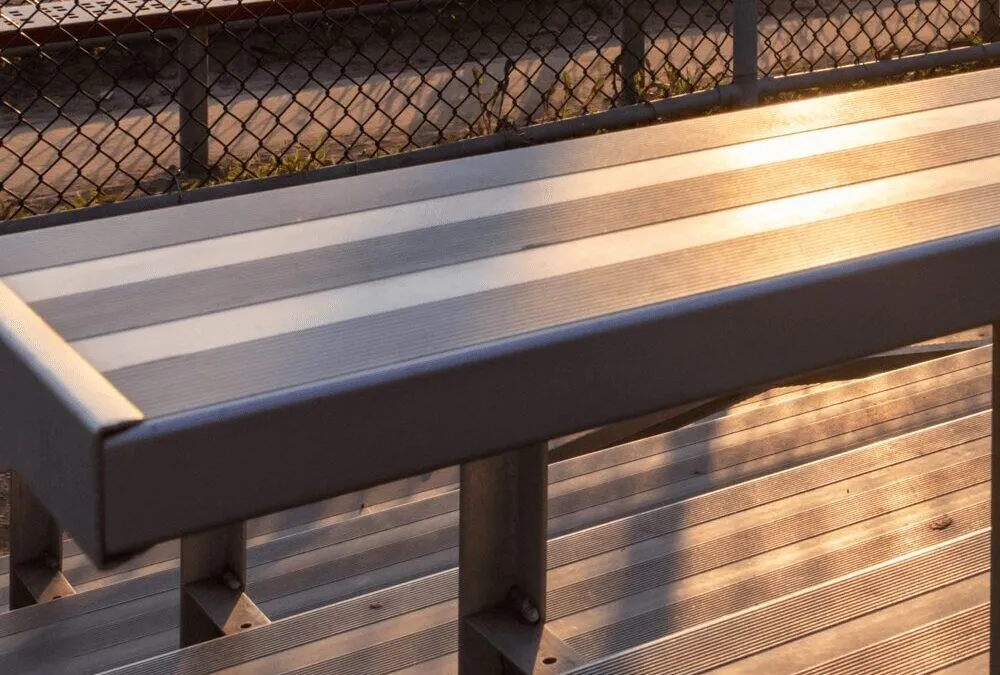
Aluminium bench seating provides a highly functional baseline that requires very little ongoing intervention. Trade professionals often specify it early in the planning phase to avoid expensive redesigns later. It’s a reliable choice for any commercial space.
How Extruded Metal Outperforms Welded Steel
Extruded metal outperforms welded steel by eliminating the weak joint points that inevitably crack under repetitive stress. Heavy public use quickly finds the flaws in poorly constructed furniture. Steel might seem stronger on paper when looking at raw material specs. The reality is that steel fabrications rely entirely on the quality of their corner welds.
- Extrusions offer continuous structural integrity along the entire length of the seating plank.
- Solid profiles don’t flex or bow when subjected to heavy, concentrated point loads from crowds.
- Eliminating traditional welds removes the tiny crevices where moisture typically gathers to start the oxidation process.
- Lightweight aluminium sections allow maintenance crews to reposition seating configurations without risking manual handling injuries.
When a weld fails, the entire bench becomes a liability hazard for the venue. This is where continuous metal profiles show their true value in commercial settings. Installers prefer working with materials that don’t require heavy lifting machinery on site. It keeps the installation quick and limits disruptions for the business.
How Marine-Grade Finishes Prevent Coastal Degradation
Marine-grade finishes prevent coastal degradation by applying a thicker, highly specialised powder coat that resists airborne salt ingress. Standard exterior paints degrade rapidly when positioned within five kilometres of the ocean. Salt spray acts as a constant abrasive force on commercial outdoor furniture. Without a dedicated protective barrier, the underlying material quickly succumbs to pitting and surface damage.
- Standard exterior grade coatings usually sit around 60 to 80 microns thick.
- Coastal venues require marine-grade applications exceeding 100 microns for adequate long-term protection.
- Textured finishes provide a thicker skin that hides minor scuffs while offering a better grip for resting patrons.
- Anti-graffiti topcoats allow cleaning crews to strip away vandalism with harsh solvents without stripping the base colour.
Facilities managers know the coastal environment is unforgiving on cheap materials. Applying the correct industrial coating stops the oxidation process before it even begins. Getting the coating right means the furniture gets a proper crack at surviving a busy summer season. There’s no point throwing money at standard finishes near the beach.
Modular Configurations for High-Traffic Layouts
Modular seating configurations manage high-traffic layouts by defining clear pedestrian pathways and preventing the scatter of loose chairs. Spatial planning dictates how smoothly a hospitality venue operates during peak hours. Crowding too many loose items into a courtyard restricts staff movement. It also creates dangerous trip hazards near emergency exits.
- Fixed linear benches positioned along perimeter walls maximise the central floor space for standing patrons.
- Backless planks act as permeable barriers, allowing groups to face either direction and interact freely.
- Interlocking modular designs let venues create continuous seating runs tailored to exact courtyard dimensions.
- Securing the furniture permanently stops patrons from dragging seats into fire egress paths during busy events.
Intelligent layouts keep the space functional and compliant with fire safety codes. Planners use heavy benches to permanently map out the desired flow of foot traffic. Venues notice a sharp improvement in service efficiency when walkways remain clearly defined. Fixed seating layouts maintain the architect’s intended flow perfectly.
Lifecycle Costing and Ongoing Maintenance
Lifecycle costing proves that metal seating presents a lower total ownership cost over ten years due to near-zero maintenance. The initial purchase price of outdoor furniture is only a small fraction of its true cost. The hidden operational expenditure of staining and repairing timber usually catches new operators off guard.
Paying a contractor to sand hardwood every six months destroys the maintenance budget.
A simple wash down with mild soapy water every few months keeps metal surfaces pristine. There’s no sanding, oiling, or expensive structural repairs required over the asset’s lifespan. Experienced asset managers calculate the break-even point for premium seating at roughly the three-year mark.
After that point, the lack of maintenance labour translates into pure operational savings. Heavy-duty metal just sits there and does the job year after year.
Frequently Asked Questions
Does metal outdoor seating require regular painting?
No, high-quality commercial furniture uses an electrostatically applied powder coat rather than wet paint. This baked-on finish resists fading and chipping for many years. It only requires a basic wash to maintain its original appearance.
What’s the typical lifespan of commercial metal benches?
A well-manufactured unit easily lasts fifteen to twenty years in a standard commercial setting. The primary metal structure won’t degrade structurally under normal environmental exposure. The cosmetic surface finish might show minor wear over decades of use.
Are there specific alloys used for public furniture?
Manufacturers typically use structural alloys like 6060 or 6106 for outdoor seating applications. These specific grades offer the perfect balance of tensile strength and corrosion resistance. They handle the repetitive stress of public use without fatiguing.
Key Takeaways
Investing in commercial exterior assets means evaluating the total lifespan costs against the initial capital outlay. Aluminium bench seating delivers a highly reliable solution that withstands severe weather conditions without requiring a dedicated maintenance crew.