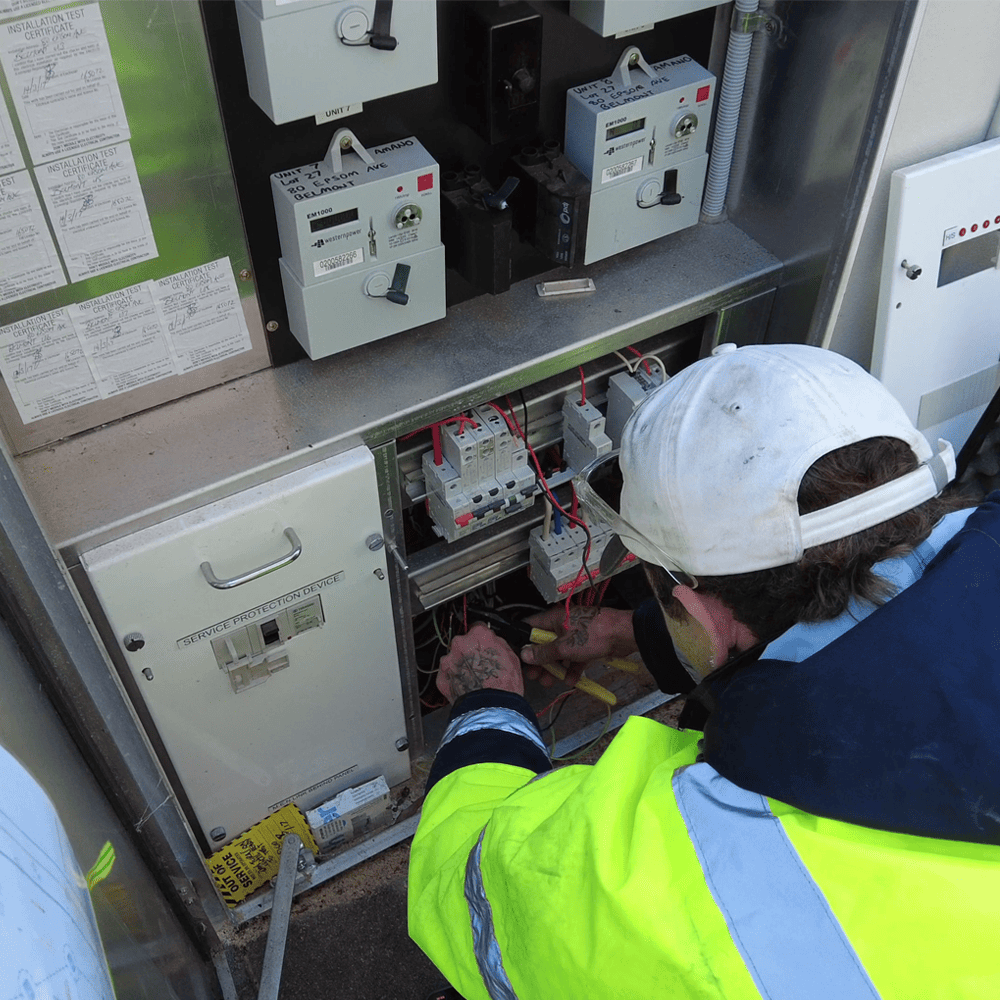
A commercial switchboard needs replacing when faults trace back to the board itself and repairs stop holding. Recurring hot joints, obsolete protection devices, corroded busbars and asbestos backing panels are the usual giveaways.
A switchboard is the enclosure that takes the incoming supply and splits it into protected circuits across a building. On larger sites, the main switchboard (MSB) feeds distribution boards on each floor or tenancy, and any of them can wear out.
A good commercial electric service provider will usually pick these signs up during routine inspections, well before a board fails outright.
What Maintenance Patterns Suggest a Switchboard Is Past Repair?
A switchboard is usually past repair when its maintenance history shows repeat callouts and fixes that don’t last. The board keeps producing new faults faster than they can be cleared.
- Repeat reactive callouts to the same board, often for a different fault each time
- Replacement parts sourced second-hand or from salvage because the breaker range is discontinued
- Consecutive electrical reports recommending the same issue be “monitored”
- Upgrade quotes for one section that creep toward the cost of a new board
Most operators reckon there’s no point throwing money at a board once the repair bills stack up like this. Each fix tends to buy less time than the one before.
Which Urgent Signs Point to a Failing Board?
A burning smell, scorch marks, buzzing or an enclosure that’s warm to the touch are the urgent signs of a failing switchboard. The trade treats them as same-day callouts, since they usually point to arcing or overheating at connections.
Several of these signs follow a pattern that’s easy to miss:
- A smell that only turns up on hot afternoons, when air conditioning pushes the board toward peak load
- Discoloured plastic around a single breaker, which often marks a connection that’s been cooking for months
- Buzzing that gets louder as more equipment comes online during the day
- Warmth concentrated on one part of the enclosure, which usually maps to a specific section of busbar
Signs that only appear under load rarely show up on a morning walk-through. Once an electrician traces them to heat damage across the board, the repair options narrow quickly. Only a licensed electrician can legally work inside a switchboard, so the diagnosis sits with them.
Which Outdated Protection Devices Signal Replacement?
Rewireable fuses and missing RCD protection are strong signs a switchboard has outlived the wiring rules it was built to. These boards often can’t be brought up to current standards without major rework.
- Rewireable ceramic fuses, which depend on the correct fuse wire being fitted every time
- Socket-outlet and lighting circuits with no RCD protection
- Breaker ranges that are no longer manufactured
- RCDs that fail trip-time testing, usually by exceeding the 300 millisecond limit at rated residual current
- Circuit labels that don’t match what’s actually connected
A residual current device (RCD) cuts power when it detects current leaking to earth, which protects people from electric shock. Under the AS/NZS 3000 wiring rules, lighting and socket-outlet final subcircuits up to 32 A in commercial work need 30 mA RCD protection. That limit rose from 20 A in the 2018 edition, so plenty of older boards fall short.
What Does a Recurring Hot Spot on a Thermal Survey Mean?
A connection that shows up hot on consecutive thermal surveys, even after being re-torqued, usually means the component has deteriorated. Tightening only restores a joint if the metal underneath is still sound.
Thermal surveys compare temperatures between similar components under normal operating load. A widely used thermography benchmark treats a difference above 15°C between matching components as a major fault needing prompt repair.
When the same joint is flagged on consecutive annual surveys despite being cleaned and tightened, heat cycling has usually softened it. A softened joint can’t hold clamping force for long, so it heats up again between surveys.
At that stage, each new survey just records a slow failure.
Frequently Asked Questions
How Old Does a Switchboard Have to Be Before It Needs Checking for Replacement?
There’s no fixed expiry date for switchboards in Australian standards. A board older than roughly 15 to 20 years that hasn’t had a load assessment against current equipment is due for a review. Whether it’s replaced comes down to its condition and whether it can take compliant alterations.
Is Frequent Tripping a Sign a Switchboard Needs Replacing?
Frequent tripping has several possible causes, including overload, earth leakage and a failing breaker. It’s a replacement sign when testing links the trips to heat damage or to parts that are no longer made. A thermal survey alongside RCD testing usually pins down the cause.
Do Ceramic Fuses Mean a Switchboard Is Outdated?
Yes, rewireable ceramic fuses are a clear sign a board predates current protection practice. Boards with ceramic fuses often lack RCD protection and may also have asbestos backing panels. Both issues tend to push the decision toward replacement.
Key Takeaways
The strongest replacement signs are heat damage that returns after repair and components that current rules or suppliers have left behind. Most of them are visible to an electrician long before the board fails. Regular inspections through a commercial electric service provider give building managers enough lead time to schedule a replacement around tenants and trading hours.