The Work Health and Safety Act 2020 (WA) sets that framework and treats signage as part of a broader duty to manage risk. Under this, safety sign compliance isn’t a box-ticking exercise a signage supplier invented to shift stock. It’s a legal duty built into how Western Australian businesses manage risk.
Why the Primary Duty of Care Makes Signage a Legal Obligation
The primary duty of care makes signage a legal obligation because it requires PCBUs to manage risk so far as reasonably practicable. Signage counts as one accepted way to do that. Section 19 of the WHS Act 2020 (WA) sets the duty in broad terms rather than a fixed shopping list. It asks whether a business did what a reasonable operator would do, given what it knew and what resources it had.
Courts weigh several things when testing whether a PCBU met that standard:
- How likely the hazard was to cause harm, and how serious that harm could be
- What the PCBU knew, or reasonably should have known, about the hazard
- Whether ways existed to eliminate or reduce the risk, including signage, and how suitable they were
- The cost of the control measured against the risk, though cost alone doesn’t excuse skipping a cheap fix
Signage rarely satisfies that duty on its own. It sits low on the hierarchy of controls WHS law runs on, ranked below eliminating the hazard or engineering it out. A yellow warning sign next to an unguarded machine still leaves the underlying risk in place.
How Specific Regulatory Triggers Turn a General Duty into a Fixed Requirement
Specific regulatory triggers turn signage from a judgement call into a fixed legal requirement once a workplace hits certain conditions. The Work Health and Safety (General) Regulations 2022 (WA) name exact situations where a sign becomes mandatory, sitting underneath the broader Act.
Common triggers include:
- Confined space entry points, which need signage warning that entry requires a permit
- Hazardous chemical storage above threshold quantities, which needs placards and, at larger volumes, triggers a manifest requirement as well
- Lifts and hoists, which must show the safe working load somewhere visible on the equipment
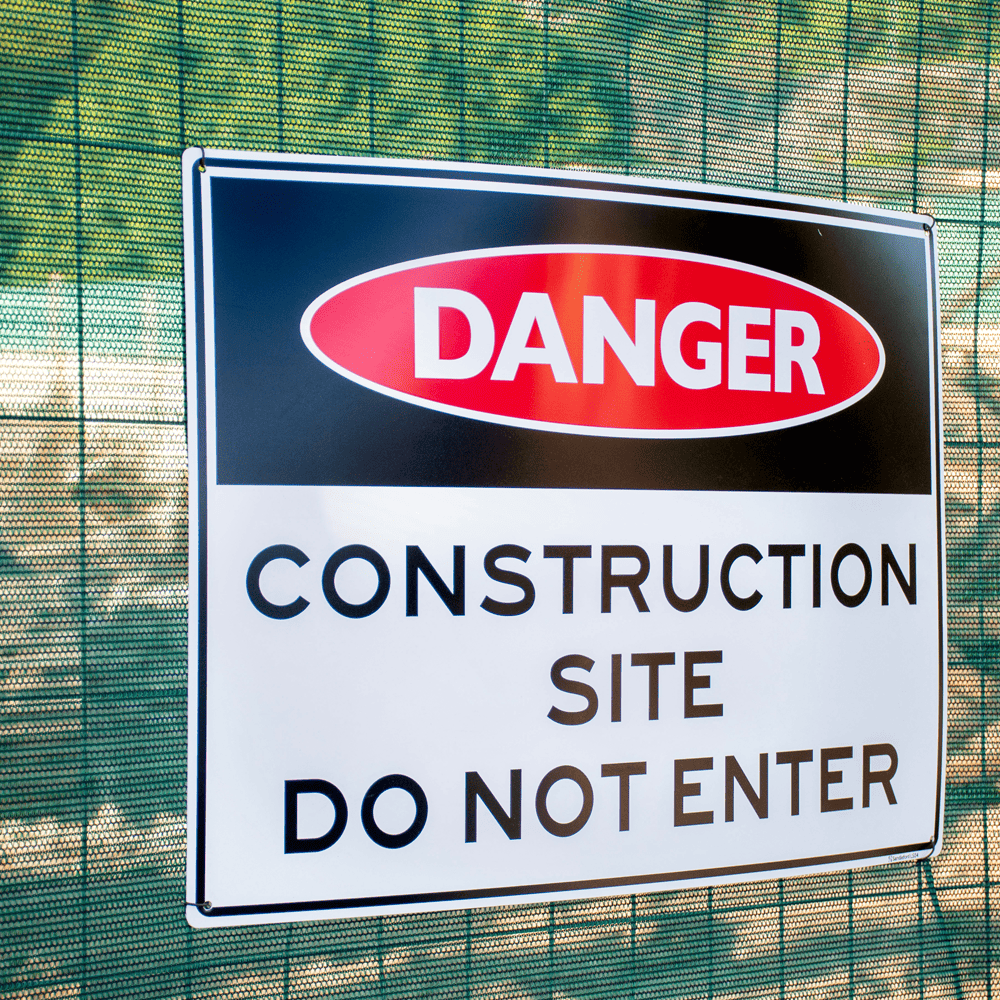
- Construction sites, where the principal contractor has to display site identification signage with a business name and contact number
Take a warehouse storing corrosive cleaning chemicals above the threshold quantity set out in the regulations. Missing a placard there isn’t a general risk management gap open to argument. It’s a breach of a specific, numbered clause, and WorkSafe WA can act on that alone, without waiting for an incident to happen first.
That’s the legal distinction worth holding onto. A general duty breach usually needs an incident, or a clear pattern, before enforcement gets serious. A specific regulatory trigger doesn’t need either.
Why Officers Can’t Distance Themselves from a Signage Failure
Officers can’t distance themselves from a signage failure because the WHS Act 2020 (WA) puts a personal due diligence duty on them. That duty sits apart from the PCBU’s own duty. Directors, senior managers, and other officers have to exercise due diligence to make sure the PCBU meets its obligations. That duty can’t be handed off to a safety officer and forgotten about.
Due diligence under the Act generally means an officer has to:
- Keep up to date knowledge of WHS matters relevant to the operation
- Understand the hazards and risks associated with the PCBU’s work
- Confirm the PCBU has, and uses, appropriate resources and processes to control those risks
- Confirm there’s a process for receiving and acting on incident and hazard information
- Verify the PCBU actually implements its own compliance processes, rather than just writing them down
Signage sits inside that verification step. An officer who’s never checked whether the confined space signs match current site conditions hasn’t discharged the duty. A policy document alone doesn’t cover that gap.
WA’s WHS laws also stop businesses from taking out insurance to cover fines imposed under the Act. Legal costs might be insurable, the penalty itself generally isn’t, which puts the financial exposure back on the company and its officers directly.
Frequently Asked Questions
Does Safety Sign Compliance Apply to Small Businesses in WA?
Yes. The primary duty of care under the WHS Act 2020 (WA) applies to any PCBU, regardless of size or turnover. A sole trader running a small workshop carries the same general obligation as a large employer, even though the signage scale will differ.
Can a Missing Safety Sign Alone Lead to Prosecution?
Not usually by itself, though it can still trigger an improvement or prohibition notice from WorkSafe WA. A missing sign becomes far more serious once it’s linked to an injury, a death, or a pattern of ignored notices. At that point, it feeds into a Category 1, 2, or 3 prosecution.
Who Is Legally Responsible for Signage on a Multi-Contractor Site?
Responsibility usually sits with more than one party at once. A principal contractor typically covers site identification signage, while individual subcontractors still hold duties for hazard and warning signs tied to their own work areas.
Final Thoughts
Safety sign compliance in WA isn’t really about the signs themselves. It’s about the duties, penalties, and evidentiary trails sitting behind them under the WHS Act 2020 (WA).
The primary duty of care sets the general expectation. Specific regulatory triggers turn parts of that expectation into fixed requirements. Officer due diligence, overlapping site duties, and an offence regime that ends in a separate industrial manslaughter charge all add weight to the same point.
A business that treats signage as a legal obligation is in a stronger position when a regulator, an insurer, or a court comes asking questions.