Enclosure integrity testing for a server room involves a design data review, preparation of the room, a door fan test and a written report. That report predicts hold time against the system’s design requirement. Most of the effort sits in the planning, since the result only counts if the room matches its condition during a fire.
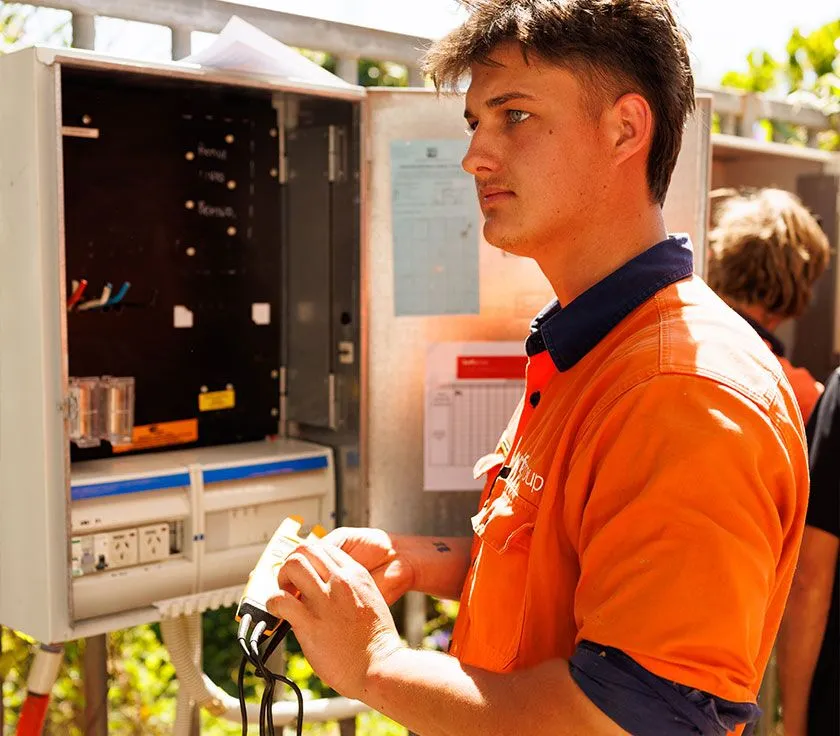
A typical job for enclosure integrity testing in WA draws on several people besides the tester. The IT team, mechanical contractor, building security and whoever looks after the fire panel each control part of how the room behaves when the system fires.
The Five Stages of a Server Room Integrity Test
A server room integrity test has five stages: information gathering, site preparation, the door fan test, reporting, and remediation with retesting if needed. The fan work is stage three, and it relies on the two stages before it being done properly.
- Information gathering, where the tester collects the design data the hold time calculation depends on.
- Site preparation, covering isolations, HVAC shutdown planning and access.
- The door fan test, with leak tracing if the room fails.
- Reporting, which compares predicted hold time with the room’s design criteria.
- Remediation and retesting, which brings the fan back once sealing works are done.
What the Tester Needs Before Arriving
Before arriving, the tester needs the suppression system’s design data, because the hold time calculation runs off those figures. Default assumptions can produce a result that’s hard to defend in a certification review.
The usual information request covers the following:
- Agent type and design concentration, since denser-than-air clean agents and inert gases behave very differently
- The net protected volume the system was designed around
- Height of the tallest protected equipment, usually the top of the highest rack
- Whether the ceiling void and raised floor void sit inside or outside the protected envelope
- The HVAC response on discharge, including which units stop and which dampers close
- The required hold time and minimum concentration, with 10 minutes the usual benchmark in design standards
The minimum concentration is a percentage of the design concentration, and the exact figure comes from the system design. A tester working from a default value can produce a pass that doesn’t reflect the certified system.
Getting the Room and the People Ready
Site preparation means putting the room into its discharge state while keeping suppression release safely isolated. The discharge state is the room’s condition once the fire panel has acted, with cooling stopped, dampers shut and doors closed. Getting the isolations wrong either spoils the result or triggers an unwanted alarm.
Typical preparation tasks include:
- Isolating suppression release and the brigade signal, while keeping the panel outputs that shut down HVAC and close dampers available
- Isolating the room’s detection zone for smoke tracing, with the monitoring provider notified first
- Booking the mechanical contractor or BMS operator to confirm the fire trip shuts down cooling and closes dampers as designed
- Agreeing a cooling shutdown window with the IT team, timed for a low-load period
- Checking that every door closer latches and that no door is wedged open
- Confirming ceiling tiles can be lifted for inspection and that no other trades are working in adjoining voids
Isolation scope varies by site and is usually agreed with whoever maintains the fire panel. IT equipment normally stays powered for the test, so the cooling shutdown is the main operational impact. A low-load window limits heat build-up in the racks.
What Happens During the Door Fan Test
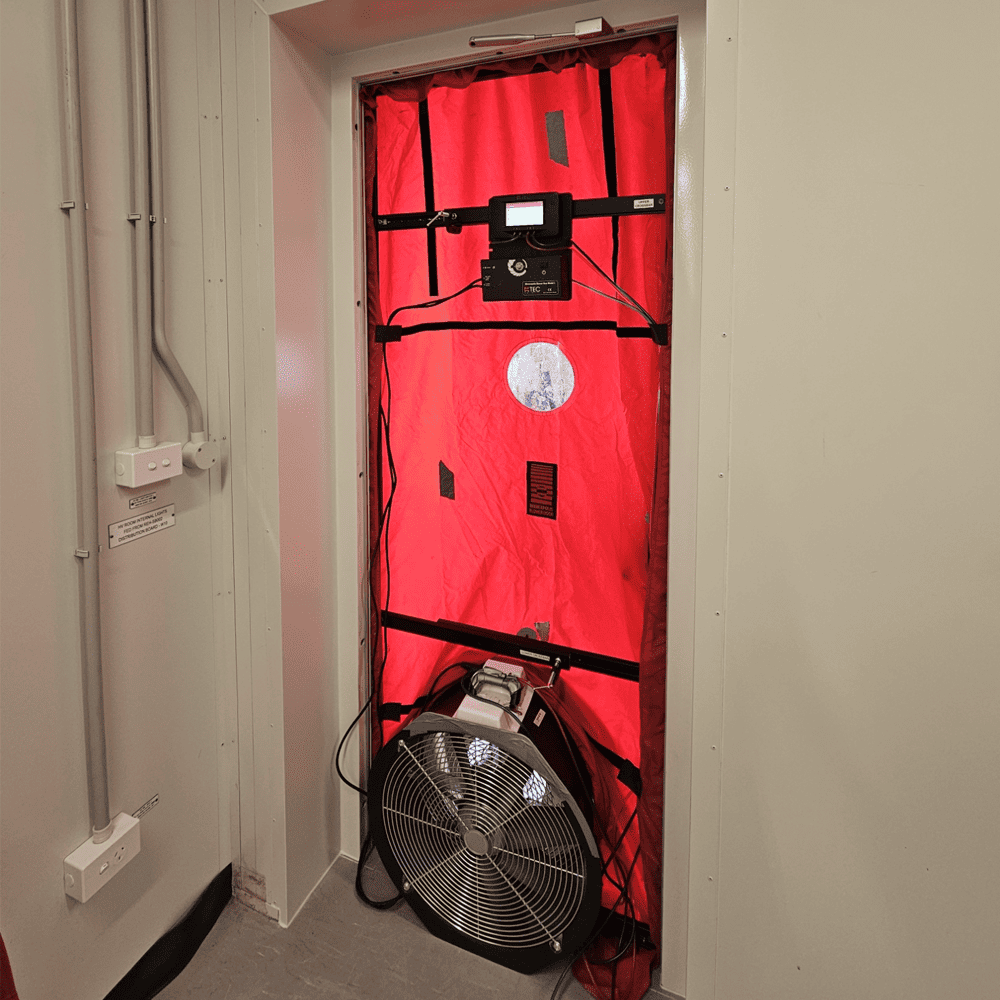
The door fan test measures how hard a calibrated fan has to work to hold the room at a series of set pressures. A leakier room needs more airflow at each pressure.
The test sequence usually follows these steps:
- The tester fits an adjustable frame and airtight panel across the doorway, then mounts the fan through it.
- Background pressure is measured with the fan off, since wind and building air movement can affect readings.
- The fan steps the room through a series of pressures, pushing air in and then drawing it out.
- The airflow and pressure data go into hold time software, which outputs equivalent leakage area and predicted hold time.
- Where the result falls short, the tester holds the room under pressure and follows smoke from a smoke pencil to each leak.
Australian practice sits under AS 4214 for gaseous extinguishing systems and AS 1851 for their servicing. The door fan method itself comes from ISO 14520 and NFPA 2001.
The panel seals the doorway that holds the fan, so testers typically give that door’s seals, drop seal and closer a separate visual check. Other doors into the room are captured in the leakage readings as normal.
Reading the Report Without Getting Lost
A useful integrity test report states the predicted hold time against the design requirement, along with the figures and assumptions behind it. Without the assumptions, results can’t be checked or compared against future tests.
A well-prepared report generally includes:
- Equivalent leakage area, which expresses all the room’s leakage paths as the area of a single opening
- The split of leakage between the upper and lower parts of the room, a key figure when the agent is denser than air
- Predicted hold time and the pass or fail outcome
- The inputs used, including room volume, protected height and agent data
- Likely leakage paths and remedial recommendations where the room fails
- Leakage figures the system designer can refer to when reviewing vent sizing
A report that records its inputs lets next year’s result be compared like for like. If the protected height or room volume has changed in between, the comparison shows it straight away.
A room predicted at 10.5 minutes against a 10 minute minimum passes. Most operators reckon that’s one unsealed cable run away from a fail, so a thin margin gets treated as a maintenance item.
Frequently Asked Questions
Does the Test Discharge Any Gas?
The test uses ordinary air, so no agent leaves the cylinders. Suppression release stays isolated for the duration. That means no refill costs and no agent exposure for anyone in the room.
What Happens If the Original Design Documents Are Missing?
The tester measures room volume and protected height on site and works from the cylinder and agent data. The hold time criteria still need confirming, ideally by the system designer or maintainer. If the room has been extended or subdivided since commissioning, the installed agent quantity may no longer suit it, and the design needs reviewing.
Does a Retest Check the Whole Room or Only the Repairs?
A retest measures the whole enclosure, because the door fan reads total leakage across the room. Any new gaps created since the first test get picked up at the same time. The new report then becomes the current record of room performance.
Key Takeaways
A server room integrity test is a coordinated site job, and the result is only as good as the preparation behind it. Owners arranging enclosure integrity testing in WA get the most reliable results when these points are covered.